Showing posts with label Horse slaughter. Show all posts

Saturday, January 21, 2012

Children as Activists The Million Horse March


From the Facebook Page of The Million Horse March
In an effort to help Save America's Horses from slaughter, Equine Welfare Alliance in cooperation with Congressman Jim Moran and Prime Minister Alex Atamanenko, is conducting a Children's Letter Writing Campaign to Congress, the President of the United States and the Canadian Parliament.

We are asking that parents, teachers, riding schools, therapy centers, all engage their children in the civic process of affecting positive change through the petitioning of their governments. We have lesson plans written by the United Federation of Teachers Humane Committee, which parents and other adults may take to the schools for them to use.

The Million Horse March – Children's Letter writing Campaign is modeled after Wild Horse Annie"s 1971 program which was instrumental in the passage of 1971 Wild Horse & Burro Protection Act.

Join them on the Equine Welfare Alliance Children's Page http://www.equinewelfarealliance.org/
Our goal is the passage of Senate Bill 1176 and House Bill 2966 the American Slaughter Horse Slaughter Prevention act and Canadian Bill 322 An Act to amend the Health of Animals Act and the Meat Inspection Act (slaughter of horses for human consumption).

Final date for submission of letters is March 20th, 2012 with presentation in DC on March 27th, 2012.

Letters, poetry, drawing, etc which convey what horses mean to the children can be sent to the following address
Million Horse March - Children's Letter Writing Campaign
Attn: Jo-Claire Corcoran
301 Tazewell Avenue
Bluefield, VA 24605

The address for the Canadian Letters will be:

Million Horse March - Children's Letter Writing Campaign
ATTN: Chelsea Burton
Box 127
Chalk River, ON K0J 1J0

The due date for the letters is March 20, 2012 and the presentation will occur on March 27, 2012. See More

Sunday, February 13, 2011

The Second Race's Valentine


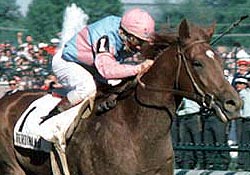
Last night I watched the HRTV "Inside Information" episode on Ferdinand. I wanted to watch the original airing of the show, as Ferdinand holds a special place in my heart, and unknowingly the hearts of many horses alive today, due to the death of Ferdinand.


A reporter years ago, wanted to know what had happened to Ferdinand and she began the process of tracing where Ferdinand had went since his original sale to stand in Japan...the answer was one that many could not fathom....he had been sent to slaughter. This news changed the trajectory of my life and many others. It wasn't possible that this had happened. How could a lovely horse, a Kentucky Derby winner no less, meet such a violent end?.


When Ferdinand ran, I wasn't a regular racing fan. I knew about him, but wasn't at the track on a weekly basis as I am now, I didn't grow up in racing, and never saw him in person. His reported slaughter was shocking to me. I didn't know about "racing's dirty secret", as it was later dubbed in the press. Because of Ferdinand, I went on to learn so much about what happens to some race horses when their careers are over.


To read more about the news story that broke in 2003, read Ray Paulick's article here:

http://www.bloodhorse.com/horse-racing/articles/17051/death-of-a-derby-winner-slaughterhouse-likely-fate-for-ferdinand

The Second Race was born from the death Ferdinand. His life is a daily valentine to the horses that we have in our foster program and to so many others since his unfortunate demise. The Second Race in a small part, hopes to pay tribute to each racing hero by changing the lives of many race horses in the years to come.

Ferdinand may not have sired many winners, he may have faded from the collective memory prior to his reported death, but he gave birth to the saving of thousands and thousands of horses since 2003.

I know that The Second Race would not exist without Ferdinand being the winner he was and I know I wouldn't be blessed to live the life I do and help the horses we have, without the lovely Ferdinand, our special valentine.

Tuesday, August 24, 2010

What You Should Consider When Rescuing a Horse from an Auction Lot

The Second Race from time to time assists with the purchase of auction/feed lot horses. These are horses that could be destined for slaughter to Canada or Mexico for European plates if they are not purchased. Our mission is to work directly with owner, trainers, and breeders at the race tracks, but with constant pleas and pictures that are hard to resist, we have assisted in the rescue of 12 horses to date via our designated 'Quarter Pole Fund'. Our latest assistance was to "Dan" a grey gelding orchestrated by Kara V. in New York. To learn more about this particular program go to http://www.thesecondrace.com/quarterpolefund.htm
Photo by Patti Walker

Here is a post we received and thought it was worth sharing from Helping Hearts Equine Rescue, that monitors an auction lot on the East Coast.


Bringing Home a "Direct from the Feed Lot" Horseby Helping Hearts Equine Rescue on Tuesday, August 24, 2010 at 6:20am

Please, be aware that horse ownership is not something to be taken lightly. Especially taking on the responsibility of a direct-from-the-pen-rescue-horse. We strongly recommend quarantine, as these horses have been exposed to a number of pathogens during a stressful time. Liken it to sending a child to school for the first time. They ALL get sick from other children's germs. Illness and vet bills is a fact of life when purchasing a Feed Lot horse. Horsekeeping expenses vary from region to region, but all experienced horsepersons will tell you that the purchase price is the cheapest part of horse purchase/ownership. With a direct-rescue, expect those up-front expenses to be higher than the norm.

I always get a little mental- twitch when I see a post offering to take in a horse if the bail, etc. are raised for it. I'm hoping that the person is aware of the EXPENSE and COMMITMENT of taking in a horse, and can afford it, especially with a directly-rescued horse. Sadly, lately, a few situations hve come to light of horses that need rescuing from their rescuers. When this sort of thing happens, terribly-- the horses suffer and the whole rescue-effort is looked upon with suspicion--accusations and mis-trust quickly follow behind that.

Please note that we do our best to post accurate info on each horse, but each horse spends less than 2 minutes being run thru the sale-ring, often the actual time is even less than that. Therefore, we cannot guarantee the accuracy of info about the horses temperament, soundness or training, as our notes are based on what is announced about each horse and our observations in a very short window of time--we are looking at dozens of horses every week in a very short period of time. The majority of these horses are WONDERFUL, and just need a bit of time to settle in. A few though, will need some work, may have been mis-represented by their sellers in regard to training and temperment. And sadly too, there have been a few cases of horses being much more "up" when they arrived at their new homes than they were in the ring. (sadly, some sellers "medicate" horses they offer for sale--If I think a horse at the sale may have been tranquilized, I mention it, I don't want anyone getting hurt). A question to ask yourself: Are you competent/confident to work thru these issues; or have the resources to work with a professional to assist in teaching your horse to be a solid citizen for you. Just because he's a low-priced rescue doesn't mean he's not worth the cost of professional assistance or training. (Sadly, I've heard that. "He was only $300, I'm not paying a trainer to work with him! It's not worth it!" -- makes me want to smack them)

Be realistic and be patient. I receive contact several times a week from Camelot-Feed-Lot-Purchasers whose horsers 'aren't working out'. I've helped network and rehome a good number of them. I've taken in a few who wound up being fine, the problem never materializing here. In a couple of recent situations where I was networking the horse, I later got calls back saying "never mind", that the issue resolved. The horse settled in, and became (1) less dominant in the pasture, (2), stopped banging at feeding time; (3) ground manners improved, etc. Horses are very social animals, they need structure, they need to know/understand where they stand in the social hierarchy. In the cases of social hierarchy/aggression in turnout----they've often had to protect themselves thru a series of pens and trailers packed wtih strange horses jockeying for position; In the case of bad-manners/aggression at feeding time, starved horses need to realize that they will be fed--every day--every time -- when that happens, they often become less anxious at feeding time and stop banging, screaming, kicking, lunging at the stall door, etc. But it takes time, sometimes weeks or months.

If you are unsure about purchasing an 'unknown quantity" from the sale list, please do consider adopting a horse that's been pulled by a rescue. Rescues get them in, QT them, vet them, evaluate them for training and temperament, often put training into them and the adoption contracts give you a safety net, should the horse NOT work out. Adopting from a rescue allows the rescue the resources to save another and repeat the process. YES, the adoption fee is more than the pull fee, but it is LESS than what YOU would spend to get a horse out of the Pen and up to that point.

This post is not meant to discourage the purchase of a Feed Lot horse, but is meant to make sure our prospective rescuers go into their labor-of-love with their eyes open.

Thank You.

Lisa (HHER)

Thursday, July 8, 2010

My Racing Heart


Yesterday, on The Second Race Facebook page, I posted the question "Who is Your Favorite Race Horse of All Time, and Why?". The answers where as expected, John Henry, Seabiscuit, Seattle Slew, Secretariat and Ruffian. There were many that felt Zenyatta was their favorite of all time. The mare has garnered a well deserved following, evidenced by the responses and love she inspires for racing. Eight Belles was chosen for her fighting spirit and untimely death following her incredible Kentucky Derby run in 2008.

What was enjoyable to read were how many of the race horses helped people through tough times in their lives. Whether famous or not, many commented on overcoming the death of a loved one, a divorce or how an emotional period of life was alleviated due to the spirit of competition and the joy of watching an equine athlete compete on the grand stage.

For me, War Emblem was the first race horse that captured completely my attention. It was 2002 and I was watching the Kentucky Derby on television at a local watering hole. I had watched the Triple Crown races for years on television, attended the races occasionally at Santa Anita, and would go to Los Alamitos a few times a year to catch the action at night. I have loved horses my entire life. My earliest memory was at three years of age, and knowing that horses would be with me in my heart forever. But for racing I was just a casual fan. I knew the famous names, but didn't follow racing. I wish I had.

War Emblem was a picture in the post parade, a sleek black Ferrari he gave me a chill, and I knew beyond a doubt he was going to win the race. The pre-race pageantry, his trainer Bob Baffert and his owner the Prince added to the charm of War Emblem. The gates opened, and the rest was history. Victor rode the colt to victory. I screamed the loudest and was hooked.

In 2003 and 2004 I watched everything that Smarty Jones did. The gorgeous chestnut with the crazy forelock, had tons of charisma. He quickly became a fan favorite from children to old timers. His heart couldn't be measured and for the first time I was caught up in the Triple Crown Fever.


Smarty seemed to be the first horse that I would see win the Triple Crown since becoming an avid racing fan two years prior. His loss to Birdstone was the singularly saddest moment for me in sports history. I am still not over it, and insult to injury was added when Ghostzapper won Horse of the Year. Smarty sadly, had been robbed again.

Those two race horses changed my viewing of racing and others after them caught my "racing heart". Brother Derek, Congaree, Rags to Riches, Afleet Alex, Curlin, and then of course Lava Man.

Lava Man, was the working man's horse. Relating to him was easy. He had the heart of a lion, a real warrior who outran his expectations and pedigree. It would take hours to explain the emotion he evokes in me to this day.


Lastly, and most importantly the horse that changed the trajectory of my life and shaped by purpose was Ferdinand. As I said I wasn't a racing fan when he ran. I did know the storied past of Ferdinand, but what was the life changer for me, was the death of our beloved Kentucky Derby winner in Japan. His reported slaughter was shocking to me. I didn't know about "racing's dirty secret", as it was later dubbed in the press. Because of Ferdinand, I went on to learn so much about what happens to some race horses when their careers are over. I learned about horses going to European markets to be food, and I learned that there weren't many places for geldings in particular to go to, when they were no longer competitive.


The Second Race was born from the beauty of War Emblem, Smarty Jones, and Lava Man but too, from the death Ferdinand. My life has changed dramatically because of each of them. The Second Race, in a small part hopes to pay tribute to each racing hero by changing the lives of many race horses in the years to come.

I can see no other way to pay back what they give to us.


Tuesday, June 15, 2010

True Cowboy Magazine Initiates a Rescue Fund for Horses


With the release of the June issue of trueCOWBOYmagazine (an online publication), came a personal message from editor Cate Crismani that caught my attention, the announcement that they are starting an Emergency Horse Rescue Fund. The fund will be monetized by subscription fees to the magazine. The goal of the Emergency Horse Rescue Fund is "saving a horse(s) from feedlots and certain cruel slaughter", said Ms. Crismani.

"Here at trueCOWBOYmagazine we are concerned with the welfare of all horses, mustangs, thoroughbreds and all breeds" The fund would offer assistance to groups who seek help to rescue directly from the feedlots.

You can help trueCowboymagazine's mission by subscribing online at www.truecowboymagazine.com or you can receive using your Iphone as well.

The Second Race applauds the efforts of Cate Crismani, and as she always signs off.....Besos!

Friday, May 7, 2010

Tolo-- A Story of Patience and Reward

The Second Race welcomes another story by one of our members, Tarra and Tolo what a great team they have become...Enjoy!


It all started on January 24th of 2007, my 8th grade year, when I woke up to find my 3 year old Quarter Pony (my first horse I ever owned, I had saved up all my birthday money and all from when I was little) on the ground showing very severe signs of colic. Had the vet out, trailer hooked up ready to get her to vet and all. 3 hours later, after many attempts to get her up and a clueless vet my pony was put to sleep. I had only had her for 11 months and was heart broken. It had taken me so long to finally buy my very own first horse that I lost hope in finding another one any time soon.

Fast forward 4 months later. I went on a trip with one of my friends I had met in 4-H to go see two horses she was going to look at to buy one of them, of course I went along, I always love a good horse adventure :) We made the 3 hour drive to Bend and 'patiently' waited around for the trailer to arrive. We got the call around 12 or 1 am and headed outside to see what two horses awaited us. Although it wasn't the two horses that were supposed to come one of the others came up really lame before and the one that was supposed to come who my friend really like came off the trailer 3 legged lame. But when Tolo (then called Splendor) walked off the trailer I told my friend that's the one you should get.

So what was so special about that skinny, neglected, not halter broke, not people friendly horse that was on a feed lot headed to slaughter? I honestly couldn't tell you but the minute my friend decided she didn't want him I was on the phone with my mom (who wasn't with me!). For just $300 I could take home this almost wild horse, I said why not?! Whats there to lose? Later down the road I find out there was absolutely NOTHING to lose from this special horse at all.

Four weeks after we got him and many frustrating days of him not letting me near him he somehow unlatched his gate and got loose. Not trusting me yet he ran full speed around our property and earned himself a 3 in deep cut in his neck, missing his jugular (and dying) by less than 1/2 and inch. The next day, while trying to cold hose him like instructed by vet we tied him up ( I will never, ever do this again). Before we even did anything he freaked out reared up got let caught on lead rope, de-gloved the back of his leg, punctured his nostril all the way through and sliced right above his eye. One emergency vet call, 4 days at the vet clinic and 3 months of stall rest/hand walking, and one summer spent solely at the barn later I had a sound, much for friendly horse from being handled at least 3 times daily to apply his meds, and one summer spent solely at the barn.

After being started on ground work he never had any set backs and we had our first ride on February 5th of 2008. Tolo has more heart than what he knows what to do with! Originally he was going to be a re-sale project because he was so small when I got him, about 14.3 hands at 3 1/2 years old but now stands almost 16 hands at 6 years old! Although he is still small for me, what he lack in physical size he makes up for with the size of his heart. This guy will do ANYTHING for me. We go swimming, run on the beach, compete in high school equestrian team in events from dressage and jumping to reining and pole bending and place good in all of them. At his first real dressage show this month he got two 70%'s one in First Level! Tolo will also be competing in two recognized three day events this summer including Inavale Farms and Caber Farms horse trials along with other dressage shows and such. Our goals for next year include qualifying for ODS Championships and USEA Championships.


Tolo has shown me that hard work and perseverance really does pay off in the end. Not only did I get a great horse who everyone has come to love and adore he has taught me so much. He has also helped continue my love for saving slaughter bound horses and since him I have helped rescue 3 other horses. He has been a great ambassador for horses on the feed lot and his story is shared with anyone and everyone that asks about him or comments on how nice of a horse he is. He is a prime example of how not only good but GREAT horses can end up on the feed lot because someone else didn't want to send the time with him to make him into the horse he is today. He truly was a diamond in the rough.

After all, one mans trash is always another mans treasure.

Tuesday, May 4, 2010

Wanna Save a Race Horse? Then Keep it to Yourself!


So you wanna save a race horse huh? Well as the title suggests "keep your mouth shut". Huh? If you are scratching your head at this point, let me share the firestorm that happened yesterday.

Yesterday the message boards and "blog world", including Facebook were lit up regarding an owner that had purportedly dumped her race horse directly to the kill buyer. This owner and trainer were "outted" by this well known, snarky blog author. With a warning to All Racehorse Owners in America, that if you did the same your name, your personal information, and biography would be posted on her blog. The woman's photo was plastered over the Internet and the attacks began. This woman having no way to defend herself, until a few kind hearted people attempted a different tactic and wrote the woman directly. Her response was posted on other blog sites, and the war of words and defamation of character continued throughout the day. Now, I don't purport to have first hand knowledge of any of the dealings that took place, and that in fact is my point-- If you as self-appointed judge and jury have the temerity to "out" all parties, than at least try to find out some facts before posting to the virtual universe.

By outting this woman, and the trainer in the manner it was, the immediate and swift response by the auction lot owner, where the horse was found, was to declare that no rescue group will be allowed on his lot to purchase the Thoroughbreds (ie. racehorses). You see he is a businessman too. And while most of us don't like the business he is in, he is allowed the freedom to have his lot. Its a private lot, therefore his allowing groups that rescue horses including race horses, on it is a mutually and sometimes divisive relationship, it is still a necessary relationship.

What some fail to realize is that an auction lot owner, often BUYS horses from other sources (knowing their market), and then allows rescue/retirement individual access to the horses that can be purchased prior to their either going through the auction ring, or straight onto the back of a truck for slaughter. This businessman, needs a continuous supply of these overpriced horses to sell to those that want to help them. This cottage industry has been going on for some time. Often horses are obtained so that the price can be "jacked up" to accommodate the greed of the auction lot owner and the sympathies of the rescues. Its a symbiotic relationship.

What doesn't factor into this arrangement, is another group of "well meaning" people (often who have never actually rescued a horse off a lot) or worked with the horsemen at the tracks, using their First Amendment freedom to screw it up!

With the advent of Facebook, and popular message groups like Alex Brown's, thousands of faceless people can sit behind their computers and shout from their keypads "FIRE", doing tremendous damage to a tenuous relationship. Quickly and often, when the auction lot owner receives trouble-- threatening phone calls, emails and other personal attacks, the ability to go on the lot is over. What does that mean? The very horses that these people think they are protecting in the future, are in fact often times sending them straight to their demise.

I read many times yesterday rantings about where are the 'Zero Tolerance' policies on horse slaughter and the race track management?. Unfortunately, its a misnomer to think that every single race track in America, has a zero tolerance plan. It would be nice, but it is factually not the case.

For instance MEC/MAGNA prior to its bankruptcy in 2009, stated that they would enforce strict guidelines to ensure that a trainer/owner found to have DIRECTLY sent a race horse from the track to slaughter could lose their stalls and licenses. The immediate problem with loose language like that, is that there can be and is often a three or even a six degree of separation when a horse is found on a lot from the race track. In the state of Washington, where this particular race horse was found, I could not find an umbrella policy in place. Links to rescues in the state of Washington where not on the Washington State Horse Racing Commission website (except for the TRF).
I understand from again, research, that there is one thoroughbred retirement facility that works with Emerald Downs, but that facility is underfunded and is not accepting horses at this time from the track. The Emerald Downs website does have an Industry Links tab, showing several thoroughbred retirement groups; inside and outside of the state. Portland Meadows a Magna owned track, and where the horse last ran on closing day---does not display on their website a policy. It does not provide links to retirement facilities as well. The NTRA has not accredited either Emerald Downs or Portland Meadows to date.

My point being that there are many things that racetrack management, horsemens groups and the Washington State Racing Commission (in this particular case)can do to protect horses. That's a given. If an owner states they no longer want a horse (and it happens for many, many reasons), the owner and trainer ARE responsible for it's safe transition. But racetracks KNOW that there are people on the back side all to willing to take a horse (for good reasons and bad), and with all the retirement, rescue groups that walk the backside, horses still slip through the cracks or onto the backs of trucks. In my opinion, there should be a 'safe haven' program at every single racetrack, funded by purse monies, totes or a program like CARMA (California Retirement Management Account)in tandem with an approved state specific rescue/retirement for the horses to go to. The rescue/retirement would then be responsible for the well being of the horse and its adoption or transition. Then if you find a horse goes to slaughter, despite the ease of all on the backside to place the horse into safety, you have some real "teeth" to go after the owners/trainers that just don't give a damn.

I agree only with the snarky author, that there is culpability to the race horses by owners, trainers, breeders and race track management. I could list many programs that are working, and that aren't. I could list policies that I know are not being adhered too, and I know much but I don't open my mouth, why? Because I want to be an advocate for the horse. Does that make me culpable too, perhaps.

What I do know is that there is more than one party to point the finger too in the "business" of horse rescue/retirement, however screaming and outting one person without facts and following proper protocol, to me is an injustice to the horse and is irresponsible. So if you aren't in the "business" of rescue, placement, or retirement, of race horses do the rest of us a favor....Be Quiet.

Wednesday, December 23, 2009

Time to Pick a New Calendar--- Here is One I Recommend

Magic Route before and Magic Route after his arrival and return to health by Southern California Thoroughbred Rescue (photos by Laurie Taylor/TMA) from the SCTR website http://www.sctrescue.org/


Several organizations, rescue and retirement agencies (horse and otherwise) are selling calendars to support their groups.

One of the calendars that I have personally been excited to see (and purchased today) is the one offered by Southern California Thoroughbred Rescue (SCTR).


SCTR has aptly named theirs "Still Winners". The featured cover boy is Luis Especial, a personal favorite of mine while he was racing the Southern California circuit.


Luis, was purchased from an auction lot on Kentucky Derby day for the princely ransom of $ 250 after earning $ 183,000 on track. This handsome dark bay is one of several horses showcasing the love, care and bloom of horses once deemed "trash", that SCTR has recycled back to their former selves in their 2010 calendar. Luis has since been adopted by a top equestrian trainer and is going to be in for a surprise (per Caroline Betts, founder and president of Southern California Thoroughbred Rescue) when training for his next professional career beginning in early Spring.


Other horses featured include Noble Gambler, Magic Route, and Sunday Match (lovingly renamed Bam-Bam and when you see his photo, you will understand why). Magic Route was a formerly starved horse that was rescued from his owner and patiently and quickly brought to life again. The transformation bears mention and notice, but pictures tell the real story and his are a tribute to the care that a horse can find itself in when taken in by SCTR. The cost of the calendar $ 24.95 plus shipping, equals $ 27.00 and is an attractive investment for the thoroughbreds that will be helped in the coming year. (Anything beyond the $ 27.00 would be appreciated).

If you would like a new calendar that makes a difference, may The Second Race suggest this one. To order go to their website http://www.sctbrescue.org/ and click on the header "2010 Calendar!", a link to PayPal is provided. If you want to send a check instead their address is SCTR, 635 Hacienda Drive, Norco, CA 92860.

Saturday, December 12, 2009

New York Racing Toughens Stand on Horse Slaughter


A chestnut Thoroughbred Mare currently on a feedlot in New Jersey, is a tattooed, ex-racer earned over $ 77,000 and is a direct descendant of Secretariat.


The New York Racing Association in a published release last Thursday, announced an official anti-slaughter policy that would introduce harsh penalties for offending horsemen. The policy would also encourage horsemen to use and support horse rescue and retirement adoptive initiatives as a recourse to sending a horse to a feedlot (knowingly or unknowingly).


According to NYRA policy any owner-trainer stabled at a New York Racing Association (NYRA) track found to have directly or indirectly sold a horse for slaughter will have their stalls permanently revoked from all New York tracks.


"We are fully committed to protecting our sport's equine athletes" said NYRA president, Charles Hayward.


Other tracks have stated similar policies, however there remains little enforcement as horses every day are sent to feedlots. Currently in New Jersey (see photo above) there are three, tattooed thoroughbreds along with a couple standardbreds. In California last Saturday, six tattooed thoroughbreds were on the lot. Several yearlings from a commercial breeder where found on the lot as well. Each state can site a tattooed, ex-racer on their lots at any given time.


The language of NYRA's policy may have a loophole in it that a horsemen could stand by, and that is stating that a horse is "sold" for slaughter. Often times an offending (or again an unwitting owner or trainer) stand by their innocence due to "giving away" a horse. The three degrees of separation is evoked often when a rescue or retirement group calls a former, owner, trainer or breeder of a located horse.


While I applaud all racing associations and race tracks that take a stance against slaughter of the very horses that employ them, I am curious how each of these tracks is actually enforcing their stances?.

Nationwide 15 race tracks have adopted no-tolerance policies that bar owners and trainers. However, the vague intrepretation and the lack of transparency into these policies by interested groups, such as The Second Race when requested, leaves public knowledge and enforcement of these same policies, difficult at best.


Time well tell, in the meantime, the thoroughbred on this page desperately needs to be saved. Her "sands of time" runs out on Sunday at 1:00 p.m. EST. Donations can be sent via PayPal to workingforthem@gmail.com


POST SCRIPT: I received word today 12/13/09 at 9:49 a.m. PST, that all of the horses that were at the auction, were saved. Including the chestnut mare. This was accomplished by using social networking sites such as Facebook, and networking emails. The sole reason for creating The Second Race, was to harness technology and the modern way we communicate, to save and help horses. Glad that this one had a happy ending!

Tuesday, October 20, 2009

Online Games and Horses-- Where is the Disconnect?


Hi I'm Haleigh and I was looking at your web site. I play on a game called horseland.com and lot of me and my friends on there post messages to stop horse slaughter I think it could help. Sometimes on horseland.com people pretend to be slaughtering there horses by not feeding them or going to the vet or farrier. Its like there mocking it, its annoying and scary. The horses on horseland (virtual) can get sick and either die (slaughters say they go to slaughter house) or they can be rescued by a group me and my friends made to save them. :). its sad to see them lowering there heads it almost looks real:(. thanks for reading! bye!


This was the post that caught my eye this morning and it got me to thinking about the disconnect between fantasy and reality. I guess the purpose of fantasy, is just that an escape, where there are no rules, boundaries or remorse for your actions. Haleigh, I would suppose can't be much older than a pre-teen and she is displaying a level of maturity with her post that many should paid heed to.


I went to the Horseland.com website to learn about this online community. The description under 'Learn More' said the following:


Horseland is an online community and virtual world. You can care for, compete with, breed, and trade your very own horses and dogs. You're the stable manager! It's the oldest and biggest online horse game.


Hmmmm nothing about the fun of disposing of your horse as the stable manager after its no longer useful. Now while it appears that I am passing judgment on the makers of this site, I am not. They can't possibly be held accountable for what is done, said or created on their online community by the several thousands playing the game. What I am passing judgment on is the moral compass that is constantly being pointed in the wrong direction and the disconnect between reality and fantasy for kids.


If a young girl like Haleigh is distressed about the uncaring fictional world she finds herself in while playing her online game and the uncaring, disposable approach her fellow community members use towards the horses. How can we help her? How can we help the other "Haleigh's" of the world that need to be reached ie. those that don't care?. How do we has a society teach that animals are living, breathing creatures that are dependent upon us for their care?. How can we teach as a society that we are not going to continue to be a disposable world be it diapers, paper plates or horses. There is too high a price to pay for that animal, that human, and the earth when we treat even a "virtual" game with such disregard. I am past the age of the generation that loves video games, virtual games or starring endlessly at building a farm or caring about Mafia wars. I do not understand the appeal at all. What I do know however, is that these games have desensitized people to "truth". Where else can the Haleighs of the world, kill 30 alien predators before going to school at 8 a.m. in the morning? Nowhere but in a fantasy. And sometimes we know that perception is reality, look at Columbine for instance. Does this seem like I am over reaching here, I don't. The ugliness of horse slaughter is real, and if the message purported in Haleigh's' post is any indication, we aren't doing a good job as a society of deciphering real pain from fantasy.


Haleigh's post to me is a cry for a rally to teach children from their earliest remembrance that we are responsible for our actions, our thoughts and for the animals given to us to have dominion over, but in a responsible, caring manner.

Monday, September 14, 2009

Freedom's Flight- The Story of a Rescued Race Horse Who Went to Hell and Back


MIAMI — When rescuers found the horse, he was tied to a palm tree on a Northwest Miami-Dade County farm where animals die for meat: a skinny, diseased wreck with rotting hooves and hide. Only the tattoo inside his upper lip hinted at his regal bloodline: Freedom's Flight, descendant of Triple Crown winners Seattle Slew and Secretariat.

"Anything that could be wrong with a horse was wrong with him," said Richard Cuoto, now Freedom's Flight's owner. "He's a fighter, but he had his head down, like, 'Just shoot me."'

Freedom's Flight's descent from the thoroughbred circuit's pampered paddocks into equine hell took just three months after a mishap at Gulfstream Park. It's not possible to document each step of his sad journey, but Cuoto, a board member of the South Florida Society for the Prevention of Cruelty to Animals, believes he was destined for the underground horse meat market.

"He was thrown away three, four times," Cuoto said.

Freedom's Flight was born Feb. 16, 2005, at Claiborne Farm in Kentucky's Bluegrass region, linked to greatness by sire and dam.

His father, Pulpit, is the grandson of Seattle Slew, who won the Triple Crown in 1977. Freedom Flight's great-great grandfather, the legendary Secretariat, won it in 1973. His mother is Heather's Flight, granddaughter of Nijinsky, great-granddaughter of Northern Dancer.

Herman Heinlein of Plantation, a retired New York landscape contractor, owns Heather's Flight and expected great things from her foal.

"We had high hopes," said Heinlein, 76, "but these things happen."

After the horse failed to draw a six-figure bid at Kentucky's prestigious Keeneland Yearling Sale, Heinlein sent him to Florida, where he raced for the first time Dec. 22, 2007, at Calder.

On April 4, 2008, after another two races, Freedom's Flight made his only run as a 3-year-old, at Gulfstream. Seconds after clearing the gate, his front leg snapped but didn't pierce the skin. He came from the back of the pack to finish third anyway.

"He's a competitor," Cuoto said. "When they're on the track, they know where the finish line is . . . The jockey didn't know he was injured. Right after finish line, he started to break down."

Trainer Jose Pinchin called Heinlein to report the injury.

"They told me his racing career was over," said Heinlein, who owns 100 horses. He faced a choice: pay to euthanize Freedom's Flight or, as Pinchin suggested, give him to Marian Brill, a 44-year veteran of Florida racing and a horse rescuer.

To a racehorse owner, an animal that can't run "is a broken machine that don't work," Brill said. "They get rid of it."

Heinlein says he kept title to the horse "because I didn't want somebody to get him back to racing."

Still a stallion, Freedom's Flight could have undergone expensive treatment for his leg then become a breeder, but "he never proved himself as a racehorse," said Brill, and since his famous ancestors begat hundreds of offspring, "Why breed the one that's farther down the line?"

Brill said she "started rehabbing him" but his injuries were too daunting. Then, she said, a man whose name she didn't know bought him for $500.

"They loaded him on a trailer and left," she said.

For the next two months, Freedom's Flight endured both insult and injury. Based on conversations with state parimutuel investigators, Cuoto believes that for part of that time, he hobbled along on his broken leg as a riding pony for kids.

And someone gelded him — ruling out any future career as a stud.

He was among several distressed horses that Officer Debbie Puentes of the Miami-Dade Police Department's Agricultural Patrol Unit spotted July 7, 2008, on Manuel Coto's property, which the Florida Department of Agriculture oversees as a "garbage-feeder farm," authorized to feed cooked garbage to swine.

"The guy buys and sells a lot of animals," said SPCA cruelty investigator Laurie Waggoner, who has responded to other calls at Coto's place. "I know they slaughter pigs and goats" without the proper permits.

Chickens, too, acknowledges Coto, who said he's in the process of coming into compliance with the appropriate regulations.

Waggoner doesn't know whether Coto butchers horses, and he adamantly denies it.

"Anybody asks me to do that, I'd send them to hell," he said. "I can kill a cow, but what are you gonna kill a horse for? I think that's bad."

Coto said Freedom's Flight was one of several horses he'd bought in Lake City "a couple of days" earlier. His price tag: $100.

An SPCA vet diagnosed Freedom's Flight with severe "rain rot," which made him lose most of his hair, bites, wounds, severe rashes, abscesses under his hooves, detoxing from steroids, a fractured right cannon — shin — bone, and strangles, a potentially deadly, highly contagious bacterial infection.

Yet sick as he was, "there was something about him," Waggoner said. "I didn't want to leave that horse there. He was still so trusting of people."

She offered Coto $200. He declined the money and allowed her to isolate the horse on his land until she could make other arrangements. Freedom's Flight spent the next five weeks in quarantine, getting treatment for strangles and, finally, his broken leg.

About a week into the horse's recuperation, Couto, the SPCA board member, checked the underside of his upper lip and saw the tattoo: I35289. The Jockey Club thoroughbred registry in Kentucky matched the number to Freedom's Flight.

"I adopted him two weeks after we seized him," Cuoto said. "By that time, I'd really bonded with him."

He says he's spent about $30,000 on vet care.

Today, Freedom's Flight cavorts in a lush pasture, his coat an iridescent copper — 1,300 pounds of rippling muscle and coltish curiosity.

Cuoto, a former motocross racer, says that Freedom's Flight changed his life. Now he's crusading against the illegal horse meat trade, which he said has earned him enemies — thus he prefers to keep his horse's whereabouts secret.

He believes that mom-and-pop butchers get $7 to $20 a pound for the meat and only sell to known customers.

"Most people buy it for medicinal purposes," he said. "They think it cures blood disorders, AIDS, and helps with the side effects of chemotherapy."

What they don't realize is that horse meat not raised for human consumption can be riddled with drugs, chemicals and disease, he said.

Freedom's Flight's story has gotten global attention. Now the SPCA hopes he'll become a star.

The group has entered him in a contest to play his famous ancestor, Secretariat, in a Disney movie.

He's the same color, has the same white "socks" and the same mannerisms, Cuoto notes.

Only the white blaze on his face doesn't match, "but they can fix that with makeup."

Friday, September 11, 2009

Bo Derek Speaks Out Against Horse Slaughter & A Retired Racehorse at the Zoo?


“There have always been thoughtless people who starve or abandon animals,” Derek says. “But in spite of rewards and careful monitoring, officials tell us that there has been almost no increase in the problem since the closing of the slaughter houses in America.

“Slaughter houses in California were closed by a ballot initiative in 1998, but studies showed that there was no rise in abandonment. In fact, there has been a significant drop in horse thefts. As a horse owner, I am very glad of the ban and am calling for an ultimate federal ban to protect all of our American horses. There is simply no excuse for painting horse slaughter as a humane end-of-life option. Some Asian cultures eat dogs and cats. Does this mean we should have slaughter facilities for them, too?”

Some of the possible solutions:
1. Make sure people are heavily penalized for the abandonment or mistreatment of horses throughout America. 2. If the economy is at fault, make sure people have ways to solve their problem in a humane and decent way. There are many rescue organizations. 3. There are people who would love to have a donated horse. Healthy older horses are quite suitable for beginners and children to learn to ride. 4. There are several drop-off centers. The University of Davis has one. There, horses can either be rehabilitated or the gentle method of euthanasia can be demonstrated to the vet students. 5. Arrange a workable system where veterinarians can charge a lower fee for euthanizing a horse for clients they know are in need. 6. Check for burial sites at landfills at a reasonable price.
The people of America need to come together to help each other and our horses. Please send an email message to your congressman and your out-of-state friends, too. We need to end this tragedy.
(Portion of an article reprinted from Santa Ynez Valley Journal September 10, 2009)

A racehorse known as In My Lifetime when he sped around Northville Downs won a retirement sweepstakes of sorts when he received a new home at the Detroit Zoo.

The 5-year-old thoroughbred, who now goes by his barn name of Buster, had been adopted by a young woman through Communication Alliance to Network Thoroughbred Ex-Racehorses (CANTER) in Emmett.

However, his new owner ran into financial problems. CANTER took him back because many retired racehorses face a sad fate, according to board member Gail Hirt.

"A lot of the horses that don't come to CANTER end up in low auctions where people -- we call them kill buyers -- buy them for $30 to $250, send them to slaughter and ship the meat to Europe," Hirt said. "We are a horse rescue but we like to be called a horse rehab."

The Utica bus driver helps find homes for retired racehorses after CANTER and Michigan State University take care of their medical needs, often surgery for knee chips and pulled tendons, and often socialization problems.

Buster had surgery about 1 1/2 years ago before he was adopted the first time. His disposition made him a good candidate for the zoo.

"He's very, very friendly," Hirt said. "These horses have been in stables for the last 3-5 years. They have to learn to be in pastures with other horses."

Buster now is living the good life in the zoo's barnyard with Trio, a 10-year-old retired racehorse accepted by the zoo earlier this year. Trio also was rescued by CANTER.

“Many horses are retired from the racing industry each year although not all are as fortunate as Buster to find a good home. He will make a great companion for Trio,” said Scott Carter, director of conservation and animal welfare.

The bay-colored gelding weighs 1,200 pounds and stands 16.2 hands at the withers. A hand equals 4 inches. A thoroughbred horse, also called Equus caballus, typically weighs 900 to 1,100 pounds and measures 15 to 17 hands.

Veterinary care for Buster and all the zoo’s animals is supported in part by proceeds from the upcoming Bank of America Run Wild for the Detroit Zoo. The 5K and 10K races and one-mile fun walk will be held on Sept. 20. Details are available at www.detroitzoo.org. Click on "events," then "run wild".

Tuesday, August 11, 2009

New Drug Free Rules Could Make it Less Feasible to Have Horses on Auction Lots


A press release from earlier this month indicates that new rules regarding the processing of horse meat for European markets may make the fight against slaughter of our race horses a bit easier. Economically, it may not be feasible for lot owners to keep horses on their lots for 180 in quarantine. Read as the Equine Welfare Alliance explains in detail the new rules:


August 3, 2009
FOR IMMEDIATE RELEASE
Contacts: John Holland
540.268.5693
mailto:hollandtech@earthlink.net

Vicki Tobin
630.961.9292
mailto:vickitobin@earthlink.net


New EU rules may end slaughter of American Horses
CHICAGO, (EWA) – The European Union (EU) and Canadian Food Inspection Agency (CFIA) have announced that the rules on slaughtering horses for human consumption are about to change radically due to concerns regarding contaminated horse meat.
The new EU rules will become effective in April 2010, requiring that either slaughtered animals have complete health records showing they have not received banned substances or a 180 day quarantine for the horses. Claude Boissonnealut, head of the CFIAs red meat programs, has indicated that Canada will likely abide by the 180 day quarantine, as mandated by the EU.
Equine welfare advocates have warned of the contamination of American horse meat for years. Substances banned from food animals range from toxic wormers to phenylbutazone (PBZ), the “aspirin” of the horse world, and even include fertility drugs that can cause miscarriages in women. “PBZ is a known carcinogen and can cause aplastic anemia (bone marrow suppression) in humans”, says Equine Welfare Alliance (EWA) member, Dr. Ann Marini, Ph.D., M.D.
But the list of contaminants is not limited to conventional drugs. “Some of the garbage ‘treatments’ that are given to performance horses included iodine-peanut oil injections along the spine, anabolic steroids, cocaine, amphetamines, opioids and even snake venom”, explains Dr. Nicholas Dodman, DVM at Tufts University.
The new rules will mean that horses coming from auctions and other sources in the US will have to be kept drug free on a feedlot for half a year. Producers estimate that feeding horses that long will more than double their cost, making them less competitive with horses from other sources. And that is likely to be only half their problem.
EWA member Christy Sheidy, of Another Chance 4 Horses, routinely rescues slaughter bound horses from Pennsylvania’s New Holland auction. Sheidy warns, “Outbreaks of diseases like strangles and shipping fever will be inevitable in these quarantine feedlots. Left untreated, many horses may die before they can be slaughtered.” Treating the horses would restart their quarantine time.
In recent years, European authorities have cracked down on horse meat producers within the EU, requiring a “passport” system that specifically documents whether a horse has received such substances. Owners must state that their horses are intended for slaughter.
USDA statistics show that in 2008, the US exported 56,731 horses to Mexico and 77,073 horses to Canada for slaughter, resulting in the second highest slaughter total since 1995. Diners abroad have no idea whatsoever what dangerous chemicals they are eating in the American horsemeat that is shipped from plants across our borders.
In an interview with EWA, Henry Skjerven, a former director of the Natural Valley Farms slaughter operation in Saskatchewan, Canada, said: “Unfortunately, North America, US and Canada, were never geared for raising horses for food consumption. The system as it stood when we were killing horses was in no way, shape or form, safe, in my opinion.”
Skjerven went on to say, “We did not know where those horses were coming from, what might be in them or what they were treated with. I was always in fear - I think that it was very valid - that we were going to send something across there [to the EU] and we were simply going to get our doors locked after we had some kind of issue with the product.”
Skjerven’s plant began killing horses in September of 2007 for the Belgium’s Velda Group following the closing of their Cavel slaughter plant in DeKalb, Illinois. Natural Valley’s horse slaughter plant was closed by the Canadian Food Inspection Agency in January of 2009, for health issues.
Unlike Canada, horses going to Mexico are killed in two types of slaughter plants. The three largest plants export the meat to the EU and will fall under the same new rules. Mexican authorities have yet to announce whether their smaller plants, that provide meat for domestic consumption, will be required to follow the new rules.
“We don’t need to eat horses. Horses are for riding, jumping and doing a whole lot of great things. They’re not food”, concluded Skjerven.

http://www.equinewelfarealliance.org/

Tuesday, July 14, 2009

Horses on the Hill Day & Horse and Owner of the Day


Today is Horses on the Hill day and time to call Congress on behalf of America's Horses - Help End Horse Slaughter! Visit http://www.horsesonthehill.org/ for more info. Please call and cross post!
As horse advocates come to the US Capitol Hill today to show their support for H.R. 503 and S. 727, the Prevention of Equine Cruelty Act, it is important for those unable to join us call their elected officials. Please follow the information below to make your three calls. Be sure to share this information with everyone you know so they can be heard. A call, an email and a visit all make a tremendous difference. Thank you! For more on horse slaughter and how to help visit http://www.every5minutes.org/.
Date: July 14, 2009
Time: 10am – 5pm
Number: Call the Capitol switchboard at (202) 224-3121 and ask to be connected to your two US Senators and US Representative’s offices just ask to be connected to your two U.S. Senators and your U.S. Representative. They’ll ask for your address and connect you. Its super easy! Your 30-second phone calls urging your legislators to “please support H.R. 503 and S. 727 to protect horses from slaughter” are critical.


Rescued (Retired Actually) Horse and Owner of the Day--- J J Bob and Ruth

The latest featured horse's story is a bit different, JJ Bob is a registered Paint (his sire was an Appaloosa and the dam was a Thoroughbred). Ruth says that she sold her jumper to claim JJ Bob off the track so she could retire him at the end of the fair season in Northern California. JJ Bob's first job after retirement was to become a pony horse at the track at Golden Gate Fields.

After Ruth left the track JJ Bob was trained to learn to participate in pole bending and barrel racing. JJ Bob was so talented he became triple A rated in both events. Ruth went on to become involved with cowboy mounted shooting and she and JJ Bob have won state, regionals,nationals and a world championship!

Prior to Ruth claiming him, as a race horse he was 2yr champion and Horse of the Year for Appalossa's in 1992. JJ Bob equaled the world record for a 1/4 mile in his 1st start as a 2yr. and holds the 4 1/2furlong track record at Vallejo. JJ Bob had 50 starts, 19 wins, 7 seconds, and 3 thirds and earned $ 125,065 during his career from 1992-1997.

Now that is what I call a race horse and a wonderful friend and find! Thank you Ruth for sharing your story.

There are many more JJ Bob's out there that can do many jobs or activities off the race track. Please contact your local equine retirement facility to see what you can do to help by volunteering, sponsoring, fostering or adopting a former race horse.

You will never regret it!

TBA Blog Roll

Followers

Search This Blog